‘Cult’ of tourniquets causing thousands of unnecessary amputations and deaths in Ukraine, say surgeons
Story by Maeve Cullinan

Ukrainian servicemen practice how to use a tourniquet in Donetsk Oblast - Ignacio Marin/Anadolu Agency via Getty Images
The tourniquet has saved many thousands of lives and limbs in war zones around the world, but misuse of the device is causing huge numbers of excess amputations and deaths in Ukraine, say top military surgeons.
Captain Rom A Stevens, a retired senior US medical navy officer who has served in Iraq, Afghanistan, and East Africa, estimates that of the roughly 100,000 amputations performed on Ukrainian soldiers since Russia’s full-scale invasion in 2022, as many as 75,000 were caused by improper use of tourniquets.
“I’ve seen tourniquets that have been left on for days, often for injuries that could have been stopped by other methods. Then [the patient] has to have their limb amputated because the tissue has died,” Captain Stevens told The Telegraph.
Tourniquets are strong bands used to stop catastrophic bleeding by cutting off blood flow, and are standard issue for most modern armies.
But if left on over two hours, they can cause tissue death, meaning the arm or leg which has the tourniquet on is no longer viable and requires amputation.
The device became standard-issue in the 2000s wars in Iraq and Afghanistan, where rapid air evacuation to military surgical teams was possible in under 60 minutes. If the tourniquet was unnecessary it was removed, and no harm was done.
But in Ukraine, where the skies are infested with drones, injured soldiers are evacuated by land, often far exceeding the safe time window for tourniquet use.
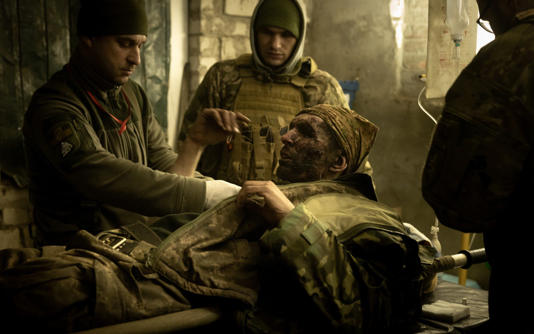
Military medics in a frontline field hospital work on a member of the Ukrainian army with head and leg injuries caused by a mine - Chris McGrath/Getty Images
This critical delay has caused tens of thousands of amputations, say experts, many of which were unnecessary because the injuries didn’t require a tourniquet in the first place.
It has also led to a sharp rise in young Ukrainians needing dialysis, said Captain Stevens who has served as a medical volunteer in hospitals in Zaporizhzhiya, Dnipro, and L’viv since the invasion in 2022.
This is because when a tourniquet is removed after being kept on too long, toxins from dead tissue flood the bloodstream, overwhelming the kidneys.
Captain Stevens helped draft the US military guidelines for tourniquet use and now wishes greater emphasis had been placed on assessing when they were needed to stop bleeding.
He fears that their successful use in wars where rapid evacuation was possible has led to a “cult-like” dependence on a tool that should be used much more sparingly.
In Ukraine, it has left “a generation of men traumatised by unnecessary amputations,” he said.

A prosthetics and rehabilitation centre for Ukrainian soldiers in Dnipro - Heathcliff O’Malley
The US Tactical Combat Casualty Care (TCCC) handbook was created for trained military medics operating in war zones in the 1990s and heavily promotes the use of tourniquets in war, describing their use as “the best method to control life-threatening bleeding”.
Widely adopted by NATO and Western armed forces in the early 2000s, the TCCC standards were quickly integrated into Ukrainian military and civilian medical training following the Russian invasion of Crimea in 2014.
Captain Stevens – though an author of the TCCC – says this was a error.
“If you have a perfect battlefield, then tourniquets work. But if you don’t – if you have a situation like Ukraine today – you can end up with a tragedy. And that’s what the Ukrainians have,” he said.
“There’s now hundreds of thousands of tourniquets that have been distributed to military forces, civilians, fire departments, and police in Ukraine. It’s become a cult, and because it saved lives in Iraq and Afghanistan, people think it’s a good idea,” he added.
While most Western militaries embed specialist medics in every unit, Ukraine’s armed forces – made up largely of conscripts and civilian volunteers – often rely on medics with only a few weeks or even days of training who are often unable to distinguish between injuries that do and don’t require tourniquets.
“The Ukrainian infantry and artillery battalions are undermanned. They can’t replace their medics when they get injured or killed,” Captain Stevens said.

Approximately 100,000 amputations have been performed on Ukrainian soldiers since Russia’s invasion in 2022 - Heathcliff O’Malley
A 2022 study by a Ukrainian military vascular surgeon, Dr Vladyslav Yatsun, found that only 24.6 per cent of war wounded patients arriving at hospital with tourniquets had injuries that justified their use to stop bleeding.
“In all other cases, the use of pressure bandages was more appropriate,” the study said.
They are also often being applied too high on damaged limbs, said Captain Stevens. “They are often taught to place on the tourniquets well above the wounds, and the result is a very high amputation, making it difficult to later fit a prosthesis,” he said.
An updated version of the Ukrainian TCCC disseminated to the armed forces in January 2024 specifically reads: “Place the tourniquet “high and tight” on the wounded extremity.”
NATO has also raised concerns about tourniquets in Ukraine.
Last year, the agency dispatched a team of medical and military experts to investigate what it described as “an unacceptable high complication rate from the use of tourniquets […] resulting in amputations, renal failure and even death.”
The organisation added: “The current situation with prolonged evacuation times requires a shift in attitude towards tourniquets,” although it has yet to formally publish its recommendations.

Rapid evacuation is difficult on many of Ukraine’s battlefields - Thomas Peter/REUTERS
Experts stress that tourniquets continue to save many lives and should not be abandoned.
Instead, they say that in places like Ukraine where rapid evacuation is difficult they should only be used in the three circumstances in which they are absolutely necessary.
The first is when a limb has been completely severed. “In that situation, you need a tourniquet, but you need to put it as low down as possible to try and save as much of the limb as you can,” said Captain Stevens.
The second is when the limb is so damaged that it cannot be saved – a decision that requires judgement and medical experience.
The third is when a person has uncontrolled arterial bleeding that cannot be stopped with direct pressure or any other method.
Captain Stevens said tourniquets are often applied by panicked soldiers, who lack the knowledge or confidence to try other methods first.
“When a [Ukrainian] soldier is injured in the field, they’re usually taken care of by other soldiers in a panic,” he said. “They see blood. They put on tourniquets because they have tourniquets. We gave them tourniquets.”
Dr Ostap Zubach, an orthopaedic surgeon who works at a major trauma hospital in L’viv, agrees that while tourniquets can be life-saving, they can also be deadly when used incorrectly.
“As a doctor, I believe that in the right hands, tourniquets are a brilliant thing. But in the wrong hands, they can be very dangerous,” he said.
A particular problem was that many soldiers did not know how to temporarily loosen a tourniquet periodically to extend the time of safe use.
“The strategy of tourniquets [in Ukraine] is just not working, especially when [the soldiers] don’t know how to convert them,” said Dr Zubach. “Many of our soldiers have no experience in the military or medicine.”

Ukraine’s armed forces – made up largely of conscripts and civilian volunteers – often rely on medics with only a few weeks or even days of training - Evgeniy Maloletka/AP
Major General Anatoliy Petrovych Kazmirchuk, Commander of the Medical Forces of the Ukrainian Army, introduced tourniquet “conversion” into the basic military training programme last year following reports of excessive amputations and limb loss at the front.
But both Captain Stevens and Dr Zubach are skeptical on what impact the new training is having.
“The problem is that under fire, people are afraid to take the tourniquets down. They’re in a rush to get that patient to a hospital surgeon and don’t stop to convert them,” said Captain Stevens.
A growing group of medics both in and outside of Ukraine are now putting pressure on the ministry of defense to move away from the TCCC handbook and develop their own set of medical guidelines for use in the Ukrainian context, factoring in long evacuation times.
“Guidelines are only guidelines. They require common sense to apply, they require professional judgement. In Ukraine, they don’t have a system for developing guidelines. Often they just take Western, US, British, NATO guidelines, and translate them, word for word into Ukrainian,” said Captain Stevens.
“But there’s a lot of resistance to changing it. The Ukrainians are taking their cue from the Americans, but our protocols were not designed for this situation,” he added.
“If you go back to World War Two and you read what the American theatre surgeons had to say about tourniquets, they said they were dangerous because they were often placed on wounds that did not require them, and then not taken off before it was too late,” he said.
“You didn’t have a rapid evacuation there either. You’re evacuating by land, over bumpy roads, in the middle of the night under fire, just like what the Ukrainians are doing now.”
Both Dr Zubach and Captain Stevens say more emphasis needs to be put on basic casualty care, like cutting off clothes to examine the wound to see the source of bleeding, use of pressure bandages, and alginates – jelly-like dressings that can absorb heavy bleeding and pack into wounds without the long-term risks associated with a tourniquet.
Both agree that tourniquets should be used only as a last resort, when all else has failed. “Soldiers and medics need to understand that when a tourniquet is placed on the Ukrainian battlefield, it usually means an amputated limb,” says Stevens.
 Visit The Telegraph


 )
)