Yeah… I know… it can be boring seeing another thread about trigger finger discipline.
However, safety is always number one in firearm training and education. There is never enough talking about it.
Why do we train and practice? Of course we do this to be better, faster, more reliable during the action, proficient, efficient… we can name it in dozen different ways.
But what always comes with training is the way how we really react in stressful situation, when there is no time for thinking and reading manual or safety procedures… we just act the way we trained.
Do we really think about 4 safety rules each time we take the firearm in the hand? Or we don’t, because it seems so obvious. But… is it really so obvious?
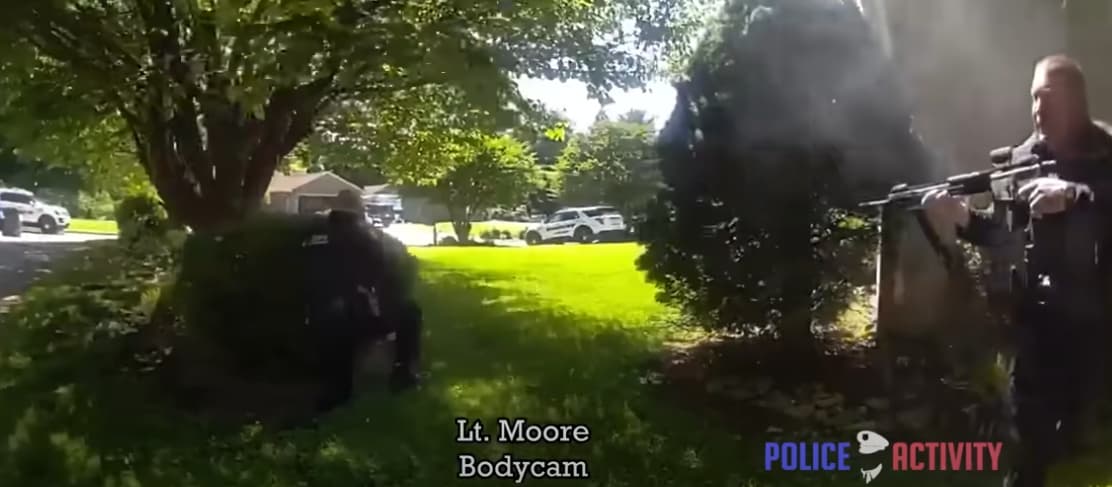
June 11th, 2024 - Rockford, Blount County, TN.
Two officers took cover behind the car exchanging gunfire with the suspect.
I really don’t expect super safety procedures… but seeing this I would never ever allow Deputy Smith handling any firearm behind me…
You can watch the whole video and count how many times he flagged his partner with finger on the trigger.
I’m not picking on those guys, they did a great job, but the point is when you are in such situation, you do everything the same way as you were training.
Watching videos of actual events is no different than Hollyweird. I’m thankful I look for boo-boos like that so that I’m extra careful about my own actions.
I saw Land of Bad last night and thought the actors did a good job in terms of trigger discipline.
I’ll keep it short. I liken trigger control to driving. Many of us have or had hellacious commutes. One thing we mastered was accelerator control. Stop and go and never putting it to the floor and ramming the car ahead. You can back out of your driveway, go down the street at 20, hit the next street and go 35, hit the boulevard and 45, then the freeway and 65, all this and never “flooring” the car; or if a gun, firing. If we put a fraction of the this practice towards trigger control this would never be a topic. But I’ll agree, for those who never practice this discipline, stay off the trigger.
Maybe this isn’t the right spot for this, but I pulled up the news and came across this article.
I am so confused by the support hand index finger. I’m going to have to go home, pull out my SIRT and see if I can even do what this guy is doing in this photo.
The photo is credited to an individual via Getty Images. Can it still be AI generated? Looks like the guy’s finger is dislocated.
Masad Ayoob talks about four levels of competence:
Unconscious incompetence Doesn’t know what he’s doing and doesn’t know he doesn’t know Conscious incompetence I don’t know what I’m doing, and I know it. Conscious competence If I think about it, I know I can do it right. Unconscious competence Reflexively do it without thinking about it. This is a “Zen state” or “in the zone.”
He addresses that there is danger when we are so familiar that we take safety for granted.
This is a right spot @Sinbad .
We can discuss anything related to proper firearm handling.
Looking at the picture - nothing wrong there. Support hand index finger can be placed the way that give the best stability for the handgun.
I’ve seen people hooking the finger like this on the picture, I’ve seen shooters pulling this finger at the front of the trigger guard. Every safe method that gives an expected results is OK.
We were taught a similar grip at Mag 40, but to me, it looks like that off hand index finger is almost in the trigger guard in this pic. It looks like that finger is about where the trigger would be if the trigger wasn’t depressed.
Maybe I’m the only one that sees it that way. If so, my bad.
It only looks this way when you see it form the side.
Sometimes shooters are using supporting hand index finger to stabilize the windage movement. If you lock the frame closer to the muzzle, less effort is needed. But not everyone can do this. All depend on your hands’ and fingers’ sizes.
I personally prefer to lock the back of the handgun with “nutcracker grip”. It doesn’t allow me to do anything with my supporting index finger other than be a part of “hinge”.
I haven’t seen this grip before myself. I would be concerned that the support hand index finger might get in the way of the trigger return if the grip shifts slightly. I would also be concerned about the finger pulling the gun slightly off target if it sympathetically contracts with the rest of the support hand fingers that are griping over the shooting hand.
I have seen people put the support hand index finger over the front of the trigger guard and some pistols seem specifically designed for this. Though it wouldn’t work with a light attached. One argument I have heard for this is the increased ability to retain the handgun if the attacker gets their hands on it. I’m not sure how much it would help or hinder recoil control.
I am not sure if this is the grip technique the shooter in the picture is trying to use or not. It’s the closest thing I’ve seen. Essentially, instead of the index finger making contact with the bottom of the trigger guard, the middle finger does and the index finger helps to wedge and stabilize the gun. It feels a bit awkward for me when I tried it, but Mas said it does help some shooters.
I know all about the finger “off” the trigger stuff & maybe for some it’s a good idea. But…I’ll tell you, when I’m going into combat (any gunfight) MY finger is on the trigger & that fraction of a second it takes for you to get yours on it, might get you killed, but my finger on the trigger, may save my life! In VN, you better be ready & I assume in the sand box, it’s the same. Shoot enough & train like it’s real combat & learn when to shoot & when not to shoot. Tom USMC VN 67-68