Any Advice for Vortex Long Range Class

Wow! Thanks for all the advice. I’m gonna try drawing a reticle and using that to zero the scope. The scope is 1st focal plane where the reticle size changes with magnification changes.

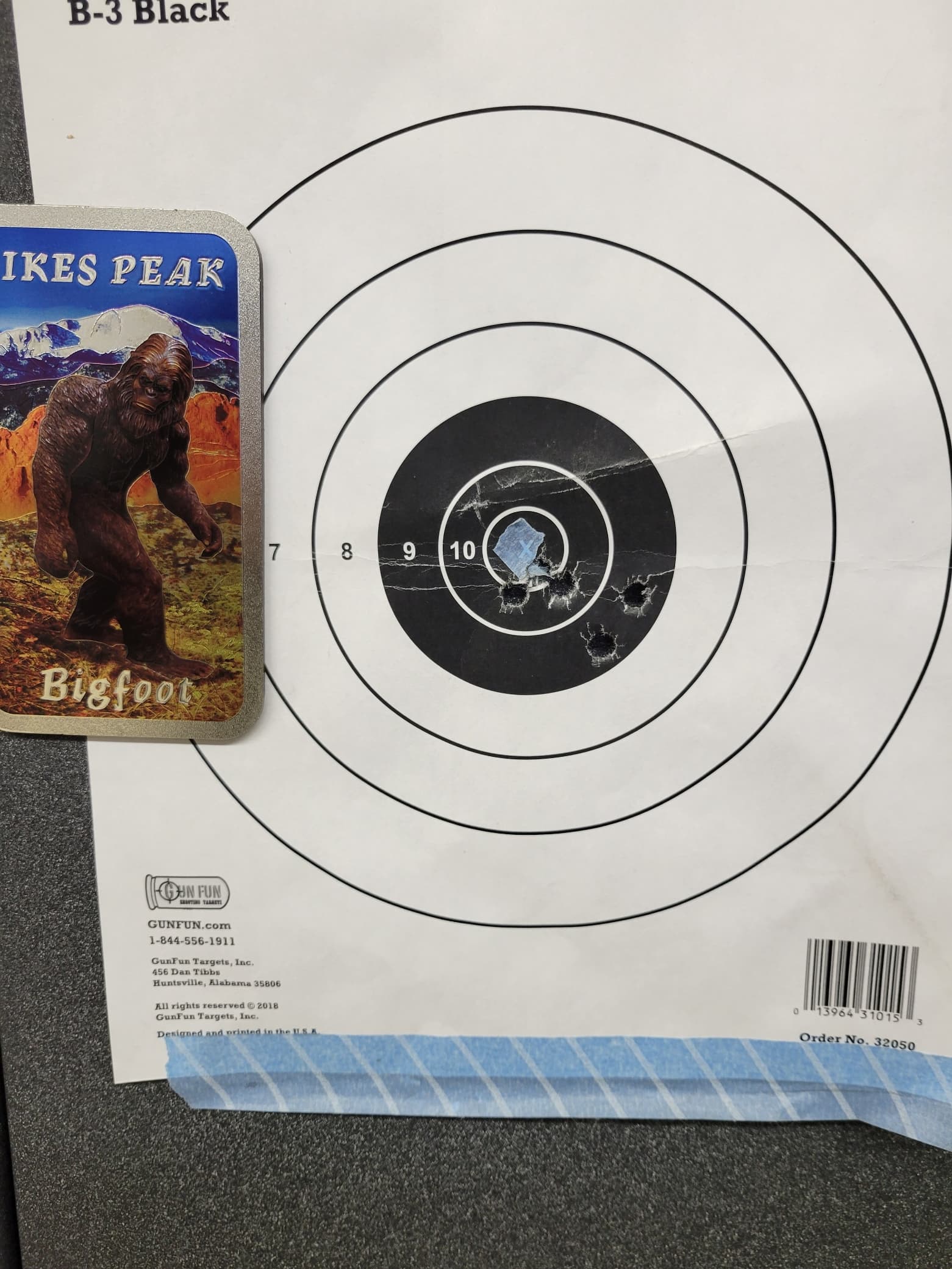
I think I have the rifle close to zero. See the target below. This is 100 yards at an indoor range using cheap PPU ammo (150 gr). The two shots low and right are me trying to find a comfortable spot behind the rifle and scope. I’m still trying to figure out what combination of bipod height, rear bag/pillows and my stiff old man body is a decent, stable platform.

My expectation is the class will have me zero the rifle again using decent match grade ammo. I suspect that when American Airlines and the TSA toss my case around during transit, that will knock off the zero in spite of my best efforts cutting a Kaizen foam nest.

5 Likes

If you are struggling to get behind the rifle use whatever mechanical advantage you can get, also use identical technique. You MUST have your face (cheek) locked to the comb of the stock (ie cheek weld). The rifle you have has a version of a “Monti Carlo stock”, it is not designed for scopes it was designed for iron sights. Hence if you stand on your hind legs to shoot it you will end up with a “jaw weld” to see through the optic same same on your belly. You can press your cheek in the same place 20 times but you can’t hold your jaw in the same place that long. Take a look at the McMillan “A” series stocks and note the difference between them and yours on the butt stock.

My first long range stick was a on a Winchester Marksman stock. Better but not perfect. I used a stock pack and several layers of “SAM Splint” (foam wrapped malleable metal medical splint) to build up the comb. It worked, the problem is (for me) when I finally got it where it needed to be I couldn’t remove the bolt. My shooting was so much more consistent I got over that.

Vortex is a good optic and I doubt seriously you will loose mechanical zero. What you will loose is atmospheric or “altitude zero”. Barometric pressure (Bp) that you get on the TV is not “true” Bp it is scaled for your altitude. If I take a mechanical Barometer from my house in VA Beach, VA reading 29.0 mmHg and fly to Denver, CO it will read about 12.0 mmHg. The weather guessers calculate actual altitude vs sea level so that that everyone is fat dumb and happy with 28 - 30 mmHg.

Pilot web sites go into detail about this because they have to calculate true Bp to figure out how much load they can take off with and how fast to get flight lift.

Cheers,

Craig6

7 Likes

Mark 697. Have you ever seen or used a ,DIGITAL , SCOPES, that a spotter is not ,NECESSARY . JUST WONDERING IF ANY ONE ELSE HAS .UNCLE SAM. HAS THEM . :bangbang::us:

I believe it is called absolute pressure. Here is a definition I found:

Absolute pressure is the measured atmospheric pressure. Absolute pressure is not corrected to sea-level conditions. To compare pressure conditions from one location to another, meteorologists correct pressure to sea-level conditions (referred to as relative pressure, or pressure relative to sea-level).

[image]

https://ambientweather.com › view

What Is The Difference Between Absolute And Relative Pressure.)

My Kestrel weather instument will measure this type of pressure for ballistic calculations. I don’t have one of the real expensive ones either.

2 Likes

Shamrock we went with com cell internet two different modems two separate . All together different modems and Adresses for different reasons :bangbang::100:

1 Like

Mark 697 put your own stickers and labels on your case and ENGRAVING ON YOUR CASE SO IT CAN NOT BE MISTAKEN FOR , ANY THING OUTHER THAN YOUR PROPERTY :bangbang:

1 Like

@Virgil_H You are “Absolute” ly correct! :wink:

Thanks for the back up!

Cheers,

Craig6

2 Likes

Thank you brother!

1 Like

Hi Mark697,

Like Craig, I also do long range shooting. I’ve not taken that class, so can’t advise there. In addition to all the excellent advice Craig gave you, I would add a few things.

Get Ryan Cleckner’s Long Range Shooting book. Very thorough, detailed information you need to know to be successful.

If your bipod has too much wiggle in it, or isn’t designed for the weight of a .308 precision rifle, you’ll struggle. Consider bringing or buying a rice-filled shooting bag like they have at the range for zeroing rifles. This is a cheap alternative to a very expensive bipod; you absolutely need a good front support.

With your off hand, make a fist and stick it under the stock of your rifle. Squeeze or release your fist to control the vertical movement of your rifle.

Make sure you’re using ammo that works well with your particular rifle. If you have a high twist rate (1:7), you’ll need heavier ammo or it won’t be as accurate the farther you go. Match grade ammo costs and arm and a leg, but it’s worth it when you go out beyond 500 yards.

Shooting 1,000 yards with a .308 is doable, but that’s really pushing the capability of that caliber. Many of the guys I shoot with will tell you that .308’s good out to about 800 yards, but trying to go beyond that can be difficult, even for an experienced shooter. In the future, you may consider a caliber change to reach out further, though I don’t think that’s necessary for your class.

Finally, learn to read the wind. I’m sure they’ll teach you that as part of the class. Remember, with the right ammo bullets tend to drop consistently. It’s the wind that messes up long range shots the most (assuming the shooter consistently applies the basics of good marksmanship).

Good luck! Let us know how it goes!
3 Likes

Two more thoughts. If you’re flying, bring duct tape with you to the airport. Once TSA has checked and cleared the rifle and everything is locked up again, you might consider putting a layer of duct tape around each end. This will let you know if someone tried to tamper with your rifle because they’ll have to cut the duct tape. Again, you can only do this after the rifle has been cleared to go on the plane.

Final thought. If you have a range near you that you can go to shoot 200-300 yards, take advantage of it as much as you can before your class. While you don’t want to develop any bad habits, you do want to get used to your rifle as much as possible before the class. Each rifle is slightly different, and the more comfortable you are with yours, the better you’re going to be prepared for the class.

3 Likes

Thanks for the advice.

I do have a 2-400 yard range nearby that I’d like to check out now that it has better management. The duct tape is a good idea, although I’m more worried about the case disappearing altogether.

2 Likes

Hello, I have a BCA 223 Wylde. It has a red/green dot on it and I just got a magnifier for it. It also has a handgrip light/laser attachment. I haven’t really tried shotting past a 100 yards before. Any suggestions? Getting the red/green dot and magnifier zero’d?

1 Like

I zeroed my rifle with a red dot at 50 yards. That puts me about an inch high at 100 yards, 3 inches low at 200 yards and should be almost 1.5 feet low at 300 though I have never shot it that far to confirm. I chose that distance because it makes my rifle pretty much point and shoot out to 200 yards.

I’ve never used a magnifier but don’t think there are any adjustments you need/can make to it aside from making sure it lines up with the red dot. I guess if it is a really cheap one with misaligned lenses it might shift how things line up so might be good to confirm you are hitting the same spot with and without the magnifier.

I use a ballistic calculator to roughly determine how low it needs to hit at 25 yards to get a 50 yard zero and do all my initial sighting in at the 25 yard distance. It’s easier to see exactly where I’m hitting at 25 though even at that distance binoculars or your magnifier help.

2 Likes

I, too, have 223 Wylde rifles that I built. One has a green dot, the other has a low power scope. I consider them to be intermediate range rifles (150 yards or less). These are not benchrest firearms, but I shoot off-hand for the most part. Getting up and down off the ground is not something my old man body does.

I took a couple carbine classes with them, fired several hundred rounds and discovered that I mounted the dot and the scope too close to my face for good eye relief. I moved the sights forward and now need to zero them properly. I use a bore-sighting laser to get close to a 100 yard zero, then some live fire. But my ammo is mostly reloads and a “party mix” of brands rather than high quality grade ammo suitable for developing a precision zero.

2 Likes

I have a cheap one of these and it has definitely paid for itself in saved ammo by getting my first shot reasonably close.

3 Likes

Okay, sounds like some great advice. Thank you
The next time I go out with one of my sons, I will do just that. 25, 50, then Shoot at 100 yrds, then try the 200yrds. Thanks again!!

3 Likes

Hi Bill168,

I don’t have a bore sighter, and I’m not totally convinced they work well. I prefer to start zeroing my rifles at 10 yards. That will get you close enough to make good general adjustments. Then move out to 25 yards once your horizontal is nearly spot on and your vertical drop is at or above your aim point. Once it’s zeroed at 25 yards, it’s only a matter of adjusting the vertical drop until you’re zeroed where you want to be.

Most red dots adjust in increments of 1/2 MOA, which translates roughly to 1/2” at 100 yards. You can use this to mathematically calculate how much to adjust your drop once you have a 25 yard zero. For example, if you want to go up 1”, you’ll need to adjust 2 clicks if you were at 100 yards. If you’re at 25 yards, that adjustment needs to be 4-times as much (4x25=100), so you would need to adjust 2 clicks x 4 = 8 clicks.

Also, don’t try to zero a rifle without a good support system. I prefer one of those rice-filled bags the range has, or you can buy your own. Trying to zero without support is a complete waste of time and ammo. Good luck!

3 Likes