
3 Likes
It’s not as exciting as Hollywood portrays it  maybe add Moriconne music
3 Likes
11 Likes
Pistol dueling had to be one of the stupidest things humans ever thought of. Two Darwin Award candidates seeing who can win the award fastest.
4 Likes
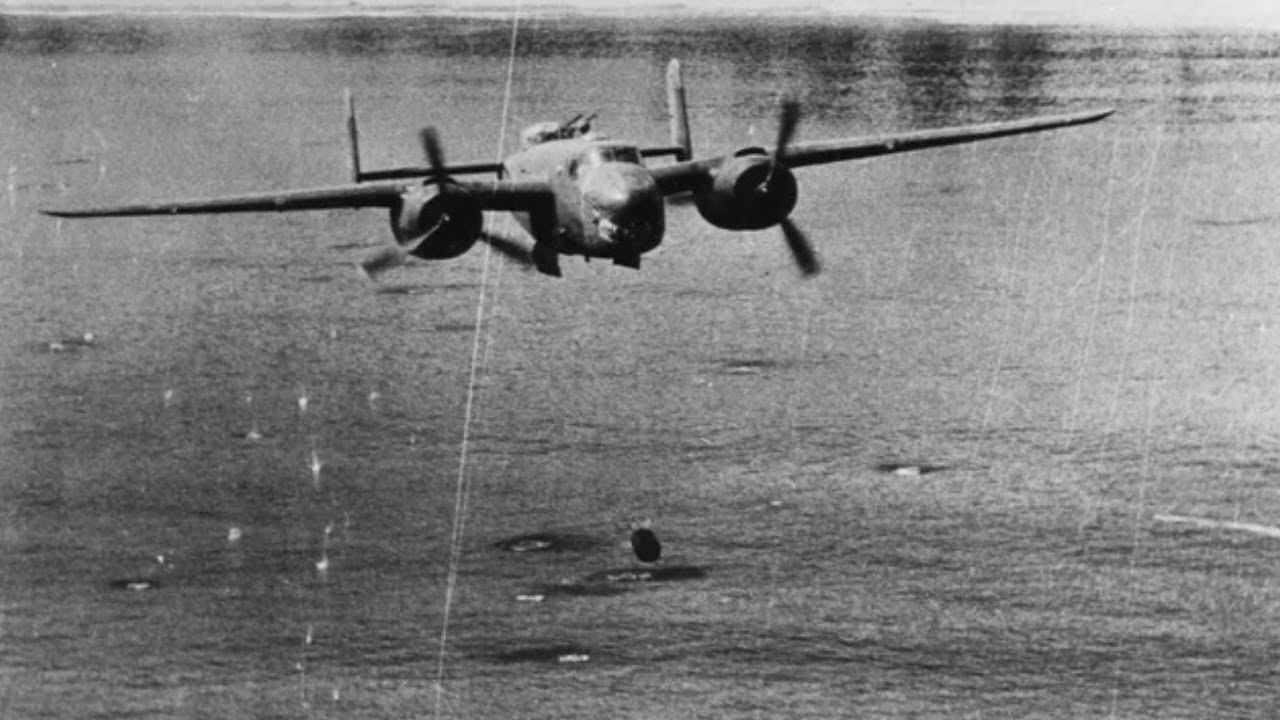
Thanks for the B-25 History lesson @Bruce26 . As a (very) amateur WWII buff, this was information I had never encountered.
5 Likes
I had not either, that’s why I posted. And “Yer welcome”.
4 Likes
Oh, I don’t know about that. Two people who each have an if-I-can-beat-you-up-that-means-I’m-right sort of mentality can choose dueling as a quick and efficient way to settle their differences once and for all, with the added benefit of causing little fuss and bother to the general public. Seems like an improvement over drive-by shootings or road rage.
Do you see that as a problem?
2 Likes
There has been accounts where both participants died, just one took a little longer than the other.
2 Likes
Is that what they call a “win/win”?
3 Likes
How the Only U.S. President’s Son Was Killed in Action | Watch
How the Only U.S. President’s Son Was Killed in Action
Only one U.S. president’s son has ever been killed in action. This video tells the story of Lt. Quentin Roosevelt, son of President Theodore Roosevelt, who lost his life as a pilot in World War I. We explore his service, the mission that led to his death, and the lasting legacy of his sacrifice.
3 Likes
This is what was usually used in dueling and could actually be rented.


These cased sets were common to the gentry of both England and America during the late 18th to early 19th century. Silver mounted sets were a sign of wealth and status. Sets like these were most often made in London or Birmingham and were the culmination of 20 or 30 specialists each doing a small portion of the work. Cased sets usually came with cleaning and loading accessories fitted in the case.
Even though dueling was illegal in England and America, it was still practiced among the ‘gentlemen’, politicians and military officers of the time. (Something we may want to see continued today in some cases) Rules of honor were established and eventually written down in the “Code Duello” by the early 19th century. (Duels among the lower classes were usually considered ‘brawls’)
On this set, everything but the barrels, locks, oil bottle and case hardware were made in my shop. They are styled after a set by Wogdon of London circa 1775. The lock parts were cast off the original locks. They are silver mounted in curly English walnut. The touch holes, bands at the barrel breeches and the lock inlays are 24K gold. The lock pans are lined with 24K gold as well. The swamped damascus barrels are 11" long and are 24 bore (.58 smoothbore). The case is walnut lined in green wool baize. Included are a walnut cleaning rod, bullet mold, leather covered flask, screwdriver, spring vice, pan brush and pewter oil bottle.
“In my opinion, this is the finest set of dueling pistols made in America in recent history.” Ed Rayl, barrel maker-West Virginia
Cased pistols prices start at $12,000 for a plain pair. A set as pictured below would run $50,000 as they constitute about 700 man-hours to produce plus the almost 3 oz of gold used.
2 Likes
WOW! Fine, fine work.
As far as accuracy goes, a well made pistol from a master craftsman can be quite accurate. I have personally witnessed a shooter place 10 shots in an 8” circle from 25 yds. He eventually lost the match; placed 6th overall.
Just like with modern pistols of good quality, it’s all about putting in the work to achieve the desired result.
P.S.: Just for general info, that .58 caliber pistol has a far different (easier to handle) recoil than a modern 9mm, let alone a .357 or .44. Just sayin’.
3 Likes
That’s why training to shoot quickly is paramount. Slow is smooth; smooth is fast. You can’t miss fast enough to win a gunfight.
5 Likes
Just for kicks. Maybe we should bring this back. 
Code Duello: The Rules of Dueling.
Reprinted from “American Duels and Hostile Encounters,” Chilton Books, 1963.
The Code Duello, covering the practice of dueling and points of honor, was drawn up and settled at Clonmel Summer Assizes, 1777, by gentlemen-delegates of Tipperary, Galway, Sligo, Mayo and Roscommon, and prescribed for general adoption throughout Ireland. The Code was generally also followed in England and on the Continent with some slight variations. In America, the principal rules were followed, although occasionally there were some glaring deviations.
Rule 1. The first offense requires the first apology, though the retort may have been more offensive than the insult. Example: A tells B he is impertinent, etc. B retorts that he lies; yet A must make the first apology because he gave the first offense, and then (after one fire) B may explain away the retort by a subsequent apology.
Rule 2. But if the parties would rather fight on, then after two shots each (but in no case before), B may explain first, and A apologize afterward.
N.B. The above rules apply to all cases of offenses in retort not of stronger class than the example.
Rule 3. If a doubt exist who gave the first offense, the decision rests with the seconds; if they won’t decide, or can’t agree, the matter must proceed to two shots, or to a hit, if the challenger require it.
Rule 4. When the lie direct is the first offense, the aggressor must either beg pardon in express terms; exchange two shots previous to apology; or three shots followed up by explanation; or fire on till a severe hit be received by one party or the other.
Rule 5. As a blow is strictly prohibited under any circumstances among gentlemen, no verbal apology can be received for such an insult. The alternatives, therefore – the offender handing a cane to the injured party, to be used on his own back, at the same time begging pardon; firing on until one or both are disabled; or exchanging three shots, and then asking pardon without proffer of the cane.
If swords are used, the parties engage until one is well blooded, disabled, or disarmed; or until, after receiving a wound, and blood being drawn, the aggressor begs pardon.
N.B. A disarm is considered the same as a disable. The disarmer may (strictly) break his adversary’s sword; but if it be the challenger who is disarmed, it is considered as ungenerous to do so.
In the case the challenged be disarmed and refuses to ask pardon or atone, he must not be killed, as formerly; but the challenger may lay his own sword on the aggressor’s shoulder, then break the aggressor’s sword and say, “I spare your life!” The challenged can never revive the quarrel – the challenger may.
Rule 6. If A gives B the lie, and B retorts by a blow (being the two greatest offenses), no reconciliation can take place till after two discharges each, or a severe hit; after which B may beg A’s pardon humbly for the blow and then A may explain simply for the lie; because a blow is never allowable, and the offense of the lie, therefore, merges in it. (See preceding rules.)
N.B. Challenges for undivulged causes may be reconciled on the ground, after one shot. An explanation or the slightest hit should be sufficient in such cases, because no personal offense transpired.
Rule 7. But no apology can be received, in any case, after the parties have actually taken ground, without exchange of fires.
Rule 8. In the above case, no challenger is obliged to divulge his cause of challenge (if private) unless required by the challenged so to do before their meeting.
Rule 9. All imputations of cheating at play, races, etc., to be considered equivalent to a blow; but may be reconciled after one shot, on admitting their falsehood and begging pardon publicly.
Rule 10. Any insult to a lady under a gentleman’s care or protection to be considered as, by one degree, a greater offense than if given to the gentleman personally, and to be regulated accordingly.
Rule 11. Offenses originating or accruing from the support of ladies’ reputations, to be considered as less unjustifiable than any others of the same class, and as admitting of slighter apologies by the aggressor: this to be determined by the circumstances of the case, but always favorable to the lady.
Rule 12. In simple, unpremeditated recontres with the smallsword, or couteau de chasse, the rule is – first draw, first sheath, unless blood is drawn; then both sheath, and proceed to investigation.
Rule 13. No dumb shooting or firing in the air is admissible in any case. The challenger ought not to have challenged without receiving offense; and the challenged ought, if he gave offense, to have made an apology before he came on the ground; therefore, children’s play must be dishonorable on one side or the other, and is accordingly prohibited.
Rule 14. Seconds to be of equal rank in society with the principals they attend, inasmuch as a second may either choose or chance to become a principal, and equality is indispensible.
Rule 15. Challenges are never to be delivered at night, unless the party to be challenged intend leaving the place of offense before morning; for it is desirable to avoid all hot-headed proceedings.
Rule 16. The challenged has the right to choose his own weapon, unless the challenger gives his honor he is no swordsman; after which, however, he can decline any second species of weapon proposed by the challenged.
Rule 17. The challenged chooses his ground; the challenger chooses his distance; the seconds fix the time and terms of firing.
Rule 18. The seconds load in presence of each other, unless they give their mutual honors they have charged smooth and single, which should be held sufficient.
Rule 19. Firing may be regulated – first by signal; secondly, by word of command; or thirdly, at pleasure – as may be agreeable to the parties. In the latter case, the parties may fire at their reasonable leisure, but second presents and rests are strictly prohibited.
Rule 20. In all cases a miss-fire is equivalent to a shot, and a snap or non-cock is to be considered as a miss-fire.
Rule 21. Seconds are bound to attempt a reconciliation before the meeting takes place, or after sufficient firing or hits, as specified.
Rule 22. Any wound sufficient to agitate the nerves and necessarily make the hand shake, must end the business for that day.
Rule 23. If the cause of the meeting be of such a nature that no apology or explanation can or will be received, the challenged takes his ground, and calls on the challenger to proceed as he chooses; in such cases, firing at pleasure is the usual practice, but may be varied by agreement.
Rule 24. In slight cases, the second hands his principal but one pistol; but in gross cases, two, holding another case ready charged in reserve.
Rule 25. Where seconds disagree, and resolve to exchange shots themselves, it must be at the same time and at right angles with their principals, thus:
If with swords, side by side, with five paces interval.
N.B. All matters and doubts not herein mentioned will be explained and cleared up by application to the committee, who meet alternately at Clonmel and Galway, at the quarter sessions, for that purpose.
One has to wonder how much Whiskey was consumed before all the rules were agreed upon. 
4 Likes
Interesting
All I know about dueling comes from Hollywood and the two most recent ones were from Back to the Future 3 and John Wick 4.
JW4 was unique in the sense that it’s the first time I saw order similar to the Code.
3 Likes
I watched from beginning to end, absolutely fascinating and informative. 

7 Likes
Thank you.
2 Likes

5 Likes
Vic Morrow!
5 Likes