
Oh… Ick. But I will keep it to myself since Samuel Jackson is there.
Ketchup is an important part of life. Mayonnaise…I can do without mayonnaise.


Please understand your firearm as there is an exception in our house. The Sig 365 (anti snag) does not have a de-cock. To carry one in the chamber is to carry it on single action. I am not comfortable for my wife to do that.
She practices drawing, racking, and firing with this particular firearm, and is proficient.
Meanwhile, her Sig P229 is carried with one in the chamber de-cocked to double action. She is good enough to be mindful of muscle memory, etc.
Hello sir. The P365 is a striker fired pistol, just fyi. As such, it has no need for a de-cocker.No worries about carrying with one in the chamber.
Thank you. I believe this is where preference comes in. The P365 is indeed manufactured with a high level of safety from an accidental discharge.
(My definition of an accidental discharge is that which occurs from a mechanical malfunction as compared to a “negligent discharge” being the result of human negligence.)
That being said, the single action function on my wife’s P365SAS is indeed a stronger pull than any other of her pistols on S/A. There is also an approximate 1/4" pre-connect zone. These two factors lend themselves to your statement. However, they are not distinctive enough for her to carry one in the chamber.
Indeed, I believe that this has been quite a discussion since the P365 came out. Thanks again, as it is an excellent topic.
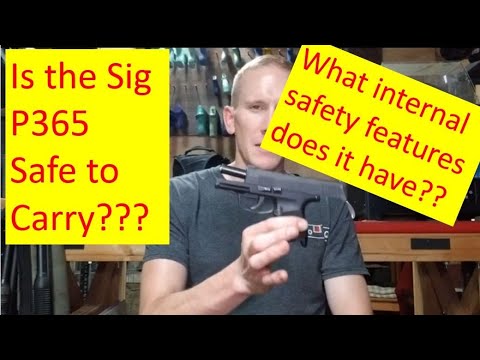
There are three types of semi-auto pistols:
- Single action (SA), like the 1911, 2011, and Hi-Power and their clones. The hammer must be cocked and the trigger only releases the hammer. If carried ready to fire, with the hammer cocked, they must have the manual safety on, thus the rubric phrase “cocked and locked.” Training and practice must include taking the safety off as you draw and present the gun. If carried uncocked, and thus not ready to fire, the training and practice must include cocking the hammer, either by pulling it back with the thumb (if a round is in the chamber), or by racking the slide (if carried with empty chamber).
- Double Action/Single Action (DA/SA), like some Sig and HK models. The trigger cocks the hammer in double action on the first shot and releases it to fire the round on that shot, but then the rest of the shots are single action since the slide reaction cocks the hammer for each subsequent shot. You need to safely uncock the hammer after your last round, so you have the decocker to do that. When carried with a round in the chamber it is ready to fire when you draw and present. You have to get used to the harder DA press on the first shot then shift to lighter SA press on subsequent shots. If carried with an empty chamber you have to rack the slide when you draw; you still must use the decocker after your last shot.
- Striker fired, like Glocks and many other models. The internal parts do not have a hammer. Instead there is a spring-loaded striker, sort of a firing pin, that hits the primer when the trigger is pulled. When loaded the trigger mechanism is in a half-cocked mode with a blocking bar in front fo the striker, which contributes to it being drop-safe. As you pull the trigger it lowers the blocking bar and completes cocking and releases the striker to fire. Striker fired guns do not need a safety, but most models are sold in versions with and without a safety, to make some buyers feel better about having the safety on. My M&P model is available both ways. I have one with no manual safety. The use of a manual safety on a striker fired gun is a matter of personal preference, and obviously affects your training and practice on handling the safety on presentation.
Roger that sir. @Craig_AR has addressed this way better than I could of. The striker trigger pull is always the same, as there is no internal or external hammer that fires the weapon. As such, a lot of folks consider a striker pistol to be carry-safe even without an external safety.
I opted for an external safety on my P365 and my M17-P320. I am used to such safeties from my Army time. When I am in an environment that causes me any concern, I often flip the safety off and rely on the inherent “safety” of the striker trigger.
When I was stationed in germany, I saw them opening mayo packs right onto their fries.
Kinda interesting article on striker fire technology:
Although that article gives a brief description of striker fired design, it is not about the technology it is about Glock’s decision not to offer an optional manual safety on their pistols. As discussed above, many other manufacturers of striker-fired handguns offer models with and without an optional manual safety.
We didn’t have AC i south Texas elementary school. All sack lunches were just put on the top shelf of the coat closet. No winder at least one kid barfed everyday
ugh mayo on sanich???
Uncomfortable carrying with one in the chamber? DA/SA will put you at ease. Just practice that long pull for the first round and you’ll be fine.