Carry ammo wasn’t as bad of a price for me when I carried a shield, now I carry a 19x…
I don’t follow the year rule anymore. I buy quality ammo (federal or gold-dot). I do try to avoid chambering the same round over and over again. I have noticed a couple rounds with clear scratches from being chambered. I try to just cycle those lower in the mag.
When I feel it’s time to switch, I’ll probably keep the same carry ammo in a spare mag and put fresh ammo in the carry gun. That way I’m only using one box of carry ammo when I cycle.
I don’t inspect every round, I do inspect the round I put in the chamber simply because I need the confidence to know my first round is good, but I am also very confident I won’t have any issues with the ammo I’m carrying for a long time.
Might not be the best practice. I’m not recommending anyone do the same, but that’s what I do. I also haven’t been to the dentist in a few years, so yeah
But if you practice dry fire every day or two and at the range once a week, you’re doing exactly that. Maybe 20 times a month or more. If you don’t practice, or don’t practice with your carry gun, then bullet setback wouldn’t be the matter of greatest concern anyway.
Probably nothing — bullet comes out and makes hole in target. Or the case ruptures and jams up the gun. Or the gun fails one way or another if the compressed powder exceeds the proof pressure by too much.
Google can fill your head with facts, gossip, and nonsense with a search on bullet setback. A couple examples which seem more or less credible:
Ammunition will certainly last decades when stored in a cool dry place. however, when left about or carried on our person, ammunition is exposed to humidity caused by perspiration at a very minimum.
I recommend to my students to cycle their carry ammunition at least once per year. I personally cycle mine every 6 months because I open carry for my security gig and am sometimes exposed to rain or snow, and my duty gun is also my carry gun (Sig 320 compact 4" 9mm).
Bullet setback is another issue. Who here shoots once a month? Probably not many. But for those of us who do, that usually means constantly cycling the top two rounds. While there is no magic number as to how often you can cycle/chamber a round before a setback occurs, the rule of thumb I often hear is 5 times. Setback has the potential to create a greater than normal pressure and can cause catastrophic failure of the firearm, meaning it could explode in your hand.
Makes sense. I wonder by what margin the pressure is increased, I doubt that standard load with setback would reach pressure of a +P load. But what if you setback a +P round? Best not to experiment I guess.
I recall reading that gun barrels are guaranteed up to 30% over SAAMI specs for the caliber. Meaning, even 0.04"/1mm of setback is likely to explode the gun. If this is true, there should be more alarm about setback rounds.
And doesn’t this raise concern about loose packed bulk ammo, especially ordered online and subject to all the bumping it endures during transport to your home?
This is one reason why two is one, one is none. Having two identical pistols, or at least perfect substitutes for one another, alleviates this issue and also reduces the wear and tear on your primary.
If you can afford the pair, it’s a great way to go.
Bonus: If something happens to the primary, you can fall right back to the secondary. Like if there is a breakage in the primary, or it gets confiscated, or whatever.
I don’t mess much with +P or +P+ loads. They make recoil considerably sharper but don’t seem to add very much to velocity, especially in shorter barrels. But yeah, you would be starting closer to a pressure threshold.
This post is not stated as factual, but rather my thoughts, and therefore up for discussion:
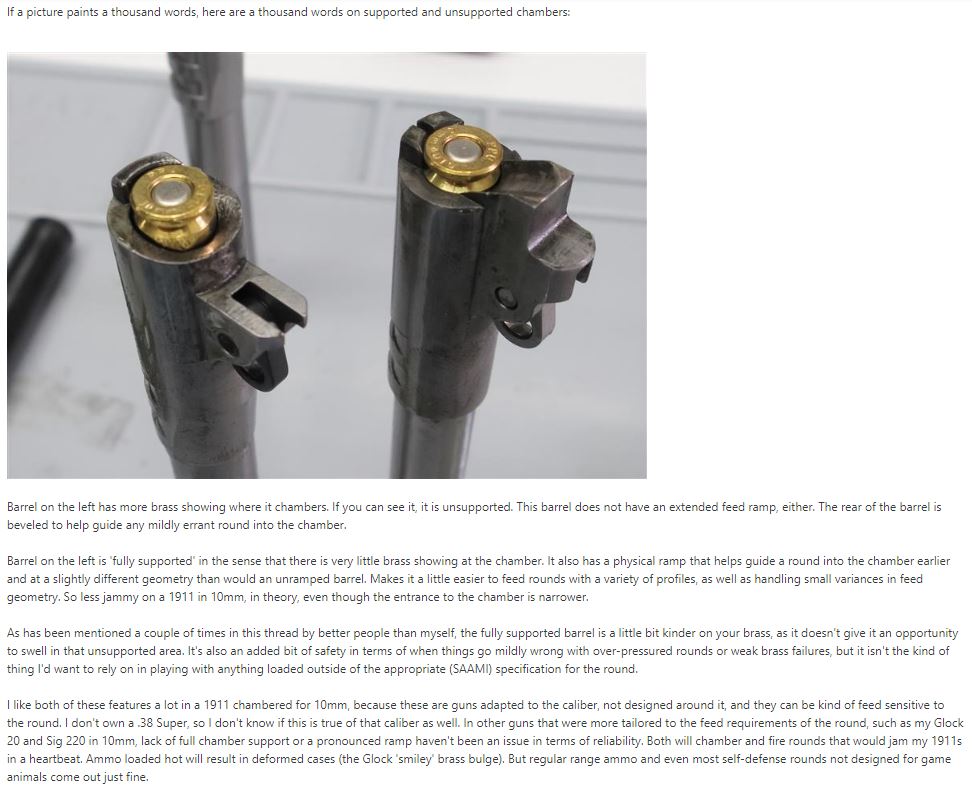
I believe the amount of acceptable setback/increased pressure is of more concern if you are shooting a firearm without a fully supported chamber barrel. From what I have read Glocks and Colts chambered in 40S&W and 10mm, both higher pressure pistol cartridges, are notorious for unsupported chamber designs. I copied this post from a 1911 forum that I think explains it better than I could:
Edit: Sorry about the tiny text. This should be more readable:
"Barrel on the left has more brass showing where it chambers. If you can see it, it is unsupported. This barrel does not have an extended feed ramp, either. The rear of the barrel is beveled to help guide any mildly errant round into the chamber.
Barrel on the left is ‘fully supported’ in the sense that there is very little brass showing at the chamber. It also has a physical ramp that helps guide a round into the chamber earlier and at a slightly different geometry than would an unramped barrel. Makes it a little easier to feed rounds with a variety of profiles, as well as handling small variances in feed geometry. So less jammy on a 1911 in 10mm, in theory, even though the entrance to the chamber is narrower.
As has been mentioned a couple of times in this thread by better people than myself, the fully supported barrel is a little bit kinder on your brass, as it doesn’t give it an opportunity to swell in that unsupported area. It’s also an added bit of safety in terms of when things go mildly wrong with over-pressured rounds or weak brass failures, but it isn’t the kind of thing I’d want to rely on in playing with anything loaded outside of the appropriate (SAAMI) specification for the round.
I like both of these features a lot in a 1911 chambered for 10mm, because these are guns adapted to the caliber, not designed around it, and they can be kind of feed sensitive to the round. I don’t own a .38 Super, so I don’t know if this is true of that caliber as well. In other guns that were more tailored to the feed requirements of the round, such as my Glock 20 and Sig 220 in 10mm, lack of full chamber support or a pronounced ramp haven’t been an issue in terms of reliability. Both will chamber and fire rounds that would jam my 1911s in a heartbeat. Ammo loaded hot will result in deformed cases (the Glock ‘smiley’ brass bulge). But regular range ammo and even most self-defense rounds not designed for game animals come out just fine."
Edit2: Note the “open” part of the cartridge starts above the extraction groove. Since the section from just above the extraction groove down is solid, that section does not require support to control expansion of the case.
“Seems credible” and “accurate” may or may not be the same thing. When I read this, I thought there were typos or some other problem with this example. Increasing 28,000 by .55 is 43,400 by my math, not 62,000 (but subtracting .55 of 62k from 62k will take you back to 28k — not the same thing). From 28k to 62k is more than doubling.
And 0.03" is not much at all. For a millimeter of setback to increase pressure 2.2x, it seems like that would have to be a very compressed powder charge to start with. The citation does not describe any details of the commercial or handload producing that test result, and I don’t have the source (Speer Reloading Manual, 1979) to verify the transcription. A pressure jump like that would not astonish me if the setback were 0.30", but I have not observed overpressure signs in current production Federal & Hornady standard pressure loads with 0.20" setback — new-in-box +P Gold Dots appear hotter.
I’m going to wander way off in the weeds for anyone with no interest in reloading, but that’s where I started thinking about whether cartridge OAL was important for more than just will it fit and function in a firearm. I was developing a new load for my first .380ACP, and found a peculiar anomaly in published data for that cartridge.
SAAMI maximums for .380ACP are 0.984" OAL and 17,000 CUP
For a 95gr FMJ, the published min–max range of powder charges for Unique:
• Lyman — 2.3 to 3.1 grains
• Speer — 3.8 to 4.2 grains
That’s odd. They’re not only quite different, the ranges don’t even overlap. So, why is that and what would be a safe load?
Maybe look at a different powder — same min–max powder charges for Winchester 231:
• Lyman — 2.1 to 2.9 grains
• Hodgdon — 2.9 to 3.2 grains
• Speer — 3.6 to 4.0 grains
Same issue — ranges don’t overlap; not clear why; not clear what is safe.
Eventually find clues in data from the outputs (95gr FMJ, Win 231):
• Lyman — min = 2.1gr = 704fps = 9,700 CUP
• Lyman — max = 2.9gr = 939fps = 15,800 CUP
Pressure jumps 63% with 38% more powder for 33% more MV — that seems a lot.
• Hodgdon — min = 2.9gr = 802fps = 13,100 CUP
• Hodgdon — max = 3.2gr = 884fps = 15,400 CUP
Pressure is up only 18% with 10% more powder for 10% more MV — very different curve, and the smallest Hodgdon load is the largest Lyman load. What gives?
The only meaningful difference I (eventually) noticed was the overall cartridge length given for essentially identical bullets. The Lyman data is for OAL = 0.900" — quite short.
The Hodgdon load finishes at 0.970" — within the SAAMI limit, but not by a mile.
Is all that pressure coming from nothing more than 0.070" of setback? I don’t have the instrumentation to verify those measurements, but that is my surmise from the published data of others. I ended up working my load all the way from the bottom of Lyman at 2.1gr to the top of Speer data at 4.0gr with COAL = 0.970"; CCI500; Fiocchi brass. I never saw any pressure signs or function problems, and finished with good groups at a MV matching my SD rounds.
I’ve considered 2mm my setback limit as an arbitrary standard since in .380, .45, and 9mm. When I shoot setback factory ammo, I check for pressure signs and have not observed any.
If you’ve followed all this, you’re nuts. Hope it helps.
Guess bullet set back is a good reason to just leave carry guns loaded when locked away. I only unload mine for dry fire, going to the range and maintenance (which usually happens after the range trip).

 Hope it helps.
 .
.